
Scheduling & Capacity Planning
Infinite, finite, or in between: which scheduler does your shop actually need?
August 18, 2026
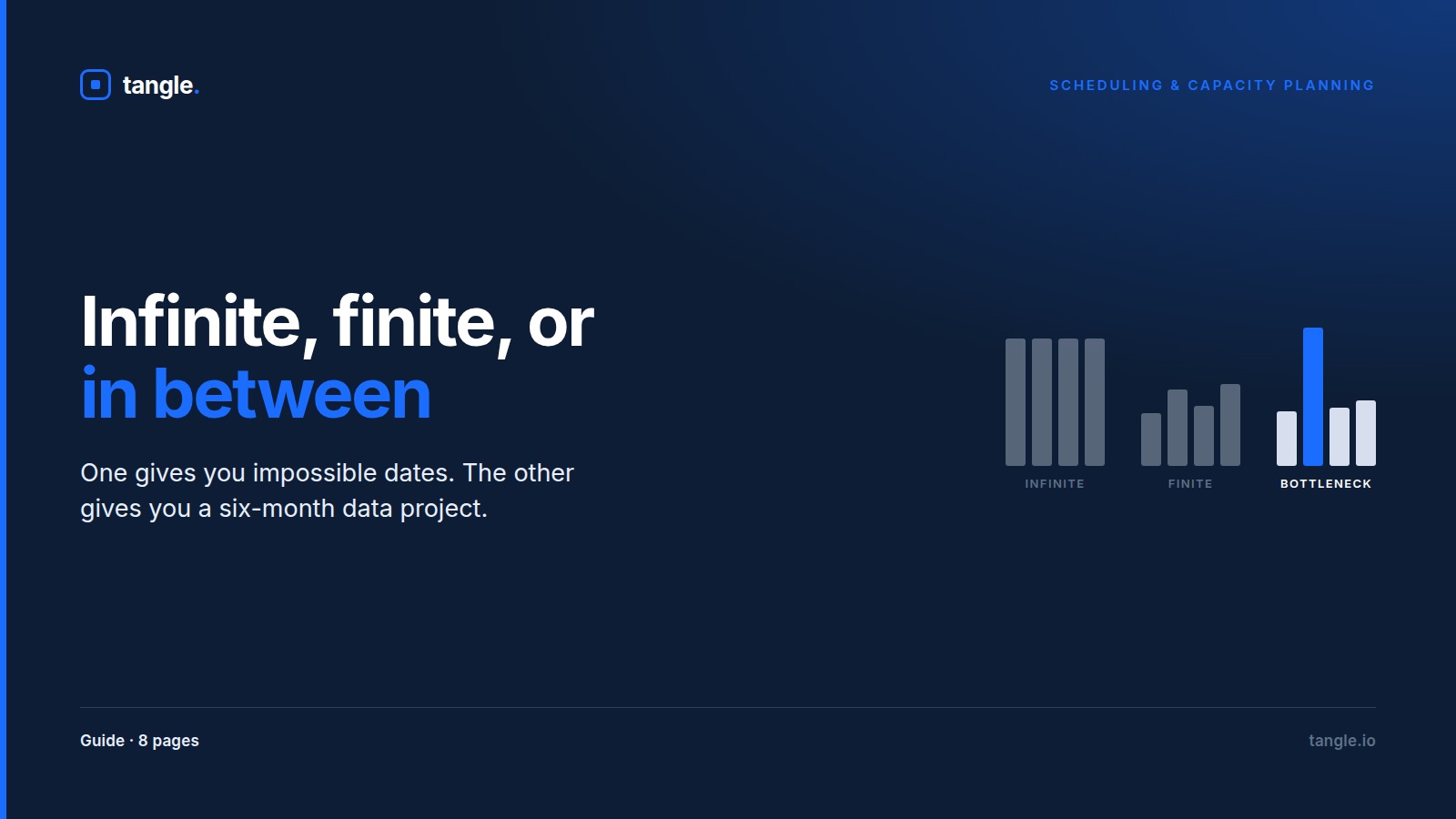
One scheduler gives you dates you cannot hit. The other gives you a six-month data project. Most shops should start somewhere else entirely.
Most scheduling software forces a choice you should not have to make. You either get a plan that is easy to read and impossible to hit, or a plan that is accurate and takes half a year of data work before anyone trusts it.
There is a third option, and it is the one most job shops should start with.
Option one: infinite capacity
Infinite-capacity scheduling works backward from the due date and assumes every machine is always available. Ask for a part in three weeks and it will tell you when to start, without checking whether the press brake is already booked solid.
The appeal is real. It is simple, it goes live fast, and anyone can read the output.
The problem is also real: it ignores your actual capacity. So it produces dates that are physically impossible, and your floor works out fairly quickly that the system is guessing. Once that happens the schedule stops being a plan and becomes a suggestion, and the real scheduling moves back to the whiteboard and the shift lead’s memory.
Option two: finite capacity
Finite-capacity scheduling respects real machine and labor limits. It will not book two jobs onto the same cell at the same time, and the dates it gives you are achievable.
That is the right answer in principle. In practice it only works if your routings, setup times, and cycle times are accurate — and in most shops they are not. Getting there is usually a six-month data project before the schedule is worth trusting.
Plenty of shops start there with the best intentions, run out of patience four months in, and end up back on the whiteboard with an expensive system nobody uses.
Option three: schedule the constraint, not the shop
For most make-to-order work, the practical answer is a hybrid. Three moves:
- Schedule the whole floor on lead times. The plan stays simple and everybody can read it. No routing archaeology required to get started.
- Watch capacity as a load view. Instead of a hard constraint that blocks scheduling, capacity becomes something you can see. Overloads surface as exceptions rather than as silent promises you have already made to a customer.
- Schedule tightly only where you are genuinely constrained. One or two work centers actually govern your throughput — the press brake, the CNC cell, the paint booth. Get accurate data for those. Leave the rest on lead times.
Bottleneck-first scheduling gets you most of the accuracy of a full finite model for a fraction of the effort. It also matches how your team already thinks about the floor. Nobody on your shop describes a busy week as a capacity utilization percentage. They say the brake is slammed.
Get the constraint right and the rest of the schedule mostly takes care of itself.
Keep a person in control
Whichever model you pick, resist the version that resequences the shop overnight without telling anyone.
Automation that quietly moves work destroys trust the first time it moves the wrong job. Automation that surfaces the conflict, shows you what it would do, and leaves the call to you builds trust instead — and gets used. The schedule should be an argument you can win, not an instruction you have to obey.
What changes with an AI-native ERP
The reason finite scheduling is hard has never really been the math. It is the data. Your standards say a setup takes 40 minutes; on the floor it takes 65 with the fixture you actually use. Every one of those gaps degrades the schedule, and keeping them current is a job nobody has time for.
This is where an AI-native system changes the economics. Tangle learns real setup and run times from what actually happens on the floor and keeps correcting itself. You get capacity-aware dates you can commit to, without the traditional implementation project that was supposed to earn them.
And because Milo — Tangle’s built-in AI engineer — works inside the system rather than alongside it, the scheduler is not a fixed product you have to adapt to. If you schedule by crew rather than by machine, run two shifts on one cell, or need a shared outside-processing step to appear in the sequence, Milo can shape the scheduling views and rules around how your shop really runs. You describe the change in plain English and preview it before anything goes live.
Where to start
- Still scheduling on a whiteboard or a spreadsheet? Start with lead times and a load view. You will get most of the benefit in weeks, not quarters.
- Have a scheduler nobody trusts? The problem is almost certainly your standards, not your software. Fix the data at the constraint first.
- Have clean routings and real discipline already? You are one of the few shops that can go finite from day one. Do it.
The full guide walks through each option with the trade-offs side by side, plus a short decision framework for working out which one fits where you are today.
→ Download the guide: Which Scheduler Does Your Shop Actually Need?
See what your current system cannot do
Bring us the scheduling problem your current setup will not handle — the shared work center, the crew-based sequence, the job that always jumps the queue. We will show you what it looks like in Tangle.
→ Book a 30-minute demo → Try Tangle free
By Tangle Software Inc. Tangle is the world’s first self-customizing ERP for manufacturers, with Milo wired into every customer’s instance. tangle.io.