
AI in Manufacturing ERP
When your ERP vendor stops improving the product
August 25, 2026
There’s a failure mode that never shows up on a status report. The ERP still boots. Orders still go in and invoices still come out. But the last meaningful update was years ago, the annual maintenance bill keeps arriving, and every request for a change comes back with a quote and a lead time. The vendor didn’t go out of business; they just stopped adapting the product to how your shop actually runs.
If that describes your system, you’ve probably already priced the standard answer. Replace it. A new ERP means twelve to twenty-four months of implementation, retraining everyone, migrating twenty years of part history, and a go-live weekend nobody sleeps through. For a lot of shops the honest conclusion is “not this year.” So the workarounds pile up instead. The spreadsheet beside the terminal. The person everyone interrupts because she’s the only one who remembers what customer X ordered in 2019. The reorder that waited a week on a report nobody ran.
The part that’s actually broken
Here’s the thing. The data in that old system is usually fine, all of it, sitting right there. Order history, part records, customer records. What’s broken is getting at it. The screen shows you one order at a time, in the order-entry layout somebody designed decades ago, and anything past that means a lookup in another module, a printed report, or a walk across the shop.
That’s not a data problem. It’s an access problem, and an access problem doesn’t require replacing the system that holds the data.
A third option
We built Tangle Xray for exactly this situation. It’s an AI layer that works on top of your existing ERP. Same screens, same system, nothing replaced.
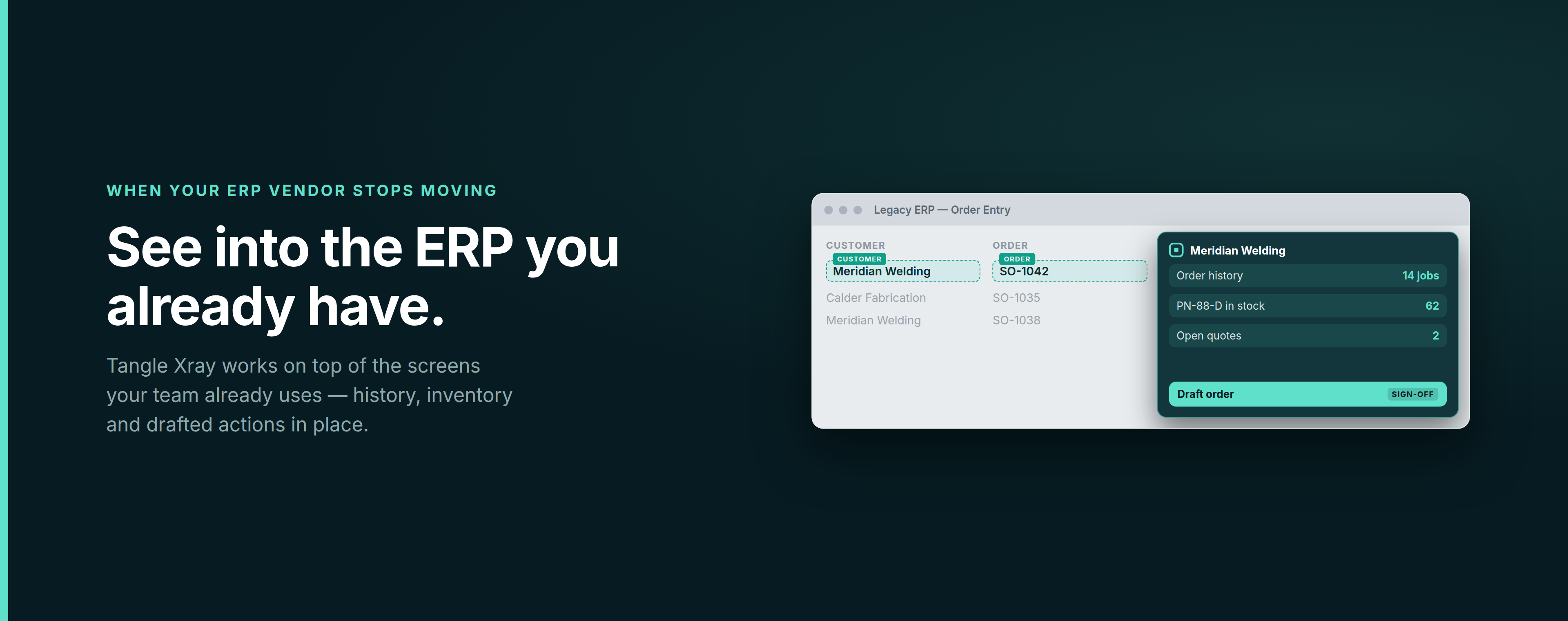
Xray recognizes what’s in front of the user. The customer, the part numbers, the order on the screen they already work in. Then it puts the useful context right beside them: order history for that customer, current inventory for that part, open quotes, and configured actions like a reorder drafted and ready for someone to sign off. A frontier AI model does the recognition and the mapping, and your team keeps working in the screen they already know.
Two things matter about how it’s built. First, it’s read-only by default; writing anything back to your system is configured per shop and stays off until you switch it on. Second, in the most common setup Xray operates the way a person does, signed in as a user, which means it can’t see or do anything that user couldn’t. There’s no rip-and-replace. Your existing ERP keeps running exactly as it is.
Where this fits in a longer story
Xray isn’t the only path, and for some shops it isn’t the right one. The way we think about it:
Tangle Xray is for seeing into, and acting on, the ERP you already have, when replacing it isn’t on the table yet. Off Ramp is Tangle’s migration capability for when it is. It runs a live sync from the legacy system into Tangle, so you can operate both in parallel and stage the go-live instead of betting everything on one weekend. And Tangle ERP is the destination, an AI-native ERP with Milo, Tangle’s built-in AI engineer, shaping the system around your workflows.
Some shops will use Xray for years and never move. Some will use it as the first step of a staged migration. Both are fine. The point is that “keep suffering” and “two-year replacement project” are no longer the only two choices.
Where it stands
Tangle Xray is a limited release. We’re opening it to a limited number of shops, selected on fit, which in practice means the ERP you run, the data access available, and a high-value starting workflow we can prove out quickly together.
If your vendor stopped moving and you haven’t, we’d like to hear from you.
Tangle is the world’s first self-customizing ERP for manufacturers, with Milo wired into every customer’s instance.